Do you need a trench drain installed on your patio, or are you looking for drainage solutions around your house?
We all love a beautiful paver patio because it creates a perfect spot to gather and enjoy the coastal Georgia lifestyle. But here’s a secret: even the prettiest patio can be a silent culprit, causing serious trouble if water drainage isn’t handled correctly.
It’s a common scenario here in coastal Georgia: heavy rains meet our slow-draining clay soils, making patio drainage incredibly important. When water consistently runs off your patio and pools near your home, it saturates the soil right along your foundation. Slowly but surely, this moisture can lead to erosion, soil shifting, and immense pressure against your foundation walls.
Let’s dive in!
In this article, we’re going to walk you through how patio drainage issues can impact your home’s foundation, what tell-tale warning signs to keep an eye out for, and why trench drains are often the smartest solution for patios. You’ll get the lowdown on how trench drain installation works, how they stack up against French drains, what a professional installation entails, and how to keep your system running smoothly for years of protection.
First, what are patio drains?
Patio drains are precisely what you would imagine. They are drainage systems designed to collect and redirect rainwater away from patios, hardscaping features, and nearby foundations. Their job is simple but critical: stop water from pooling on your patio or soaking into the soil next to your home, where it can cause erosion, paver failure, and foundation damage.
On patios, especially paver patios, rainwater has nowhere to soak in naturally unless you install a permeable patio, which is more for walkways/driveways. Without a drain, water follows the path of least resistance, often toward the house or down slope to an area where pooling may occur.
However, installing patio drains can help intercept runoff and direct it to a safe discharge point or repurpose it (see drainage ideas here). Now that you know the purpose of patio drains, let’s examine the top drainage solutions you can choose from!
Top Drainage Options for Patios
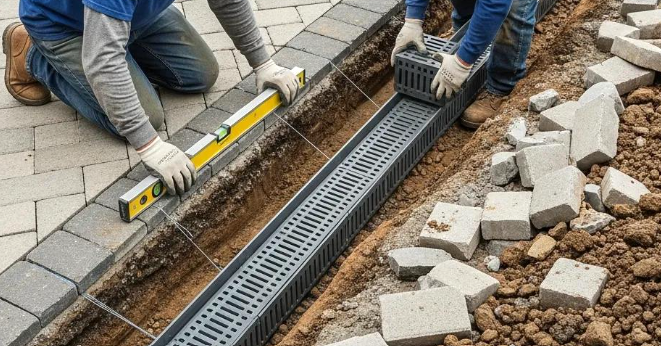
Below are some of the top drainage solutions we recommend for our clients here at Coastal Hardscapes! In a few, you will also see our process for installing linear trench drains for the Savannah area!
1. Trench Drains (Linear Drains) – Best Overall for Paver Patios
Trench drains are surface-level channels (think gutters) installed flush with the patio that capture water before it soaks into the soil near the foundation. They are ideal for large paver patios, flat yards, and areas where water flows toward the home/or pools elsewhere.
Trench drains are highly effective in coastal Georgia because they manage heavy rainfall and prevent clay soil saturation. This is often the most reliable solution for patio runoff and foundation protection.
2. French Drains – Best for Subsurface Water Issues
French drains are underground systems made of perforated pipe and gravel that collect water after it enters the soil. They are helpful when patios stay soggy due to high groundwater or poor soil drainage.
While effective below grade, French drains are not ideal for managing surface runoff alone and are often paired with trench drains for full protection. We let homeowners know that installing a French drain can also be costly because of the intense labor and engineering/design.
3. Hybrid Drainage Systems
Best for severe or complex drainage problems, hybrid systems combine trench drains for surface runoff with French drains for subsurface moisture. These are recommended when patios experience surface pooling and prolonged wet soil beneath. Many homes in Savannah and Richmond Hill benefit from this approach when clay soils and flat lots create multiple drainage challenges.
4. Regrading and Slope Correction
Best for mild drainage issues, simply regrading adjusts the pitch of the patio or the surrounding yard so water flows away from the home naturally. This works best for minor pooling issues but is often insufficient on its own in heavy rain or clay soil conditions. Regrading is commonly used in combination with trench drains or catch basins where the water flows.
5. Catch Basins and Area Drains
Catch basins are ideal for low spots since they collect water at specific low points in or near the patio and connect to underground piping. They are helpful where water collects in one area but are less effective for managing sheet flow across large patio surfaces. They are often used as part of a larger drainage system.
6. Permeable Pavers
Permeable pavers allow water to pass through joints into a prepared stone base below, similar to a French drain. While helpful for reducing runoff, they still require proper subsurface drainage and are not a standalone solution in clay-heavy soils. Additionally, permeable pavers work best when combined with trench drains or subsurface systems, and are better for driveways or walkways, not patios.
How Do You Know If Your Paver Patio Is Secretly Harming Your Foundation?
A common issue we see is that patios right up against your home can cause foundation issues if water is not drained properly. These drainage problems rarely show up all at once, and in Savannah, Richmond Hill, and Pooler – especially in flat, clay-heavy neighborhoods – the earliest warning sign is often standing water along the patio edge after rain.
If water lingers for more than 24 hours, it usually means runoff is not being directed away from the home, which means you will want to look at this quickly!
Other exterior red flags include eroded soil near the foundation, gaps forming between the patio and the house, or pavers that have begun to settle or shift near the structure. These changes signal soil washout beneath the patio and repeated moisture exposure at the foundation line.
Interior signs can include damp lower walls, water stains, musty odors, white mineral deposits on masonry, or new cracks in foundation walls or drywall. Catching these issues early allows drainage problems to be addressed before foundation repairs become necessary.
Why Patio Water Puts Your Foundation at Risk
When water pools near your foundation, it creates hydrostatic pressure—water pushing sideways against foundation walls and footings. Coastal Georgia’s clay soils make this worse because they absorb and hold moisture long after rainfall ends. As soil becomes oversaturated, it loses strength, leading to uneven settlement, cracking, and structural stress.
Runoff from paver patios also accelerates erosion beneath the patio base. As soil washes out, pavers sink and redirect even more water toward the home, creating a cycle that worsens over time. That’s why intercepting surface water at the patio level is one of the most effective ways to protect both your patio and your foundation.
How Trench Drains Become Your Foundation’s Best Friend Against Patio Water Runoff
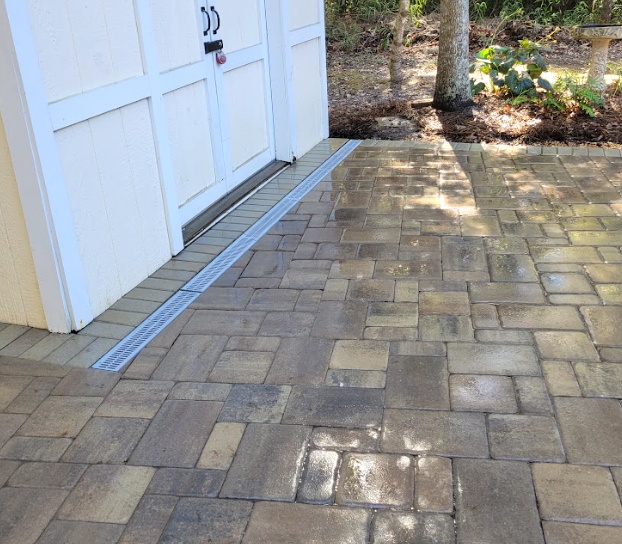
Imagine a trench drain as a discreet, linear gutter built right into your patio surface. Its job is simple: capture all that runoff water before it has a chance to soak into the soil near your foundation. It then channels that water safely away through an outlet pipe to a designated discharge point.
Trench drains are particularly brilliant for homes with expansive paver patios, which we see a lot of in Pooler and Richmond Hill developments. By catching water right at the patio’s edge, these drains dramatically reduce soil saturation, stop erosion, and significantly ease the hydrostatic pressure pushing against your foundation walls.
For coastal Georgia homeowners, trench drains offer a straightforward and dependable way to manage surface runoff, all while keeping our beautiful outdoor living spaces looking great and fully usable.
How do trench drains for patios work?
At its core, a trench drain is a narrow channel, installed flush with the ground, and topped with a removable grate. Water flows into the grate, travels through the channel, and then exits via a connected outlet pipe. It’s all about gravity doing the work, moving water away from your patio and foundation – which is why getting the slope and placement just right is absolutely crucial.
You’ll typically find a few key parts:
- the channel itself,
- the grate,
- a sturdy concrete bedding,
- the outlet pipe, and
- sometimes a catch basin to trap any sediment.
For patios, polymer concrete channels are a popular choice because they’re strong, durable, and look really clean. Knowing how these pieces fit together helps you understand what makes a system last, how much weight it can handle, and what kind of upkeep it will need.
Benefits of Trench Drain Installation for Your Patio
Installing a trench drain brings a host of long-term perks for homeowners across Savannah, Pooler, and Richmond Hill. The most immediate win? A dramatic reduction in standing water, meaning your patio stays usable and enjoyable even after those heavy coastal Georgia storms.
Beyond that, trench drains protect your patio by stopping soil erosion beneath your pavers, helping keep your surfaces level and edges crisp. But the most significant benefit, hands down, is how they slash the risk of foundation damage by actively diverting water away from those vulnerable spots.
When they’re designed and installed correctly, trench drains are surprisingly low-maintenance and deliver reliable performance for years. That makes them a brilliant investment for any coastal Georgia home.
Trench Drain vs. French Drain: Which One Is the Right Fit for Your Paver Patio?
Deciding between a trench drain and a French drain really boils down to where your water problem is coming from. Trench drains excel at managing surface runoff from patios, while French drains are designed to handle water that’s already infiltrated the soil or to address high groundwater levels.
For the majority of patio-related drainage headaches in Savannah and Pooler, trench drains are usually the superior choice because they intercept water before it reaches the soil. French drains are typically a better fit when your moisture issues are starting below ground, not from water flowing across the surface.
Sometimes, the ultimate protection comes from an innovative combination of both systems.
Surface vs. Subsurface Drainage Systems
Surface drainage systems, like our trusty trench drains, catch water right at ground level. This makes them perfect for hardscape areas where water runoff is immediate, and you can pretty much predict where it’s going. They’re visible, easy to check on, and generally simple to maintain.
Subsurface systems, such as French drains, work by collecting water that has already soaked into the soil. While they’re hidden from view, they can sometimes clog over time and are a bit trickier to service. Knowing this key difference empowers you to pick the absolute best solution for your unique property.
When Is a Trench Drain Your Go-To Over a French Drain?
A trench drain is definitely the right call when you see water flowing across your patio directly toward your home, or pooling right along the foundation edge. Those flat or gently sloped paver patios, so common in Richmond Hill neighborhoods, are prime candidates for a trench drain installation.
However, if your main concern is groundwater or persistently soggy soil away from your paved areas, a French drain might be a better fit. And remember, many homes actually get the best protection from a smart combination of both systems.
Our Process: Professional Trench Drain Installation by Coastal Hardscapes
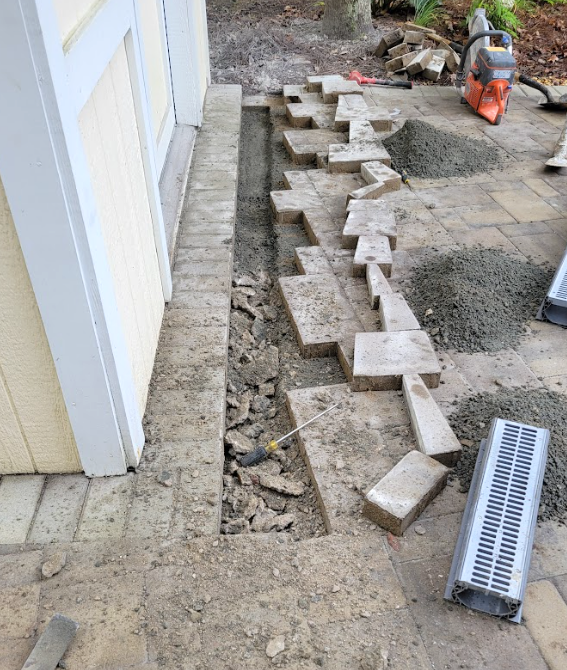
At Coastal Hardscapes, we follow a meticulous, structured process for professional trench drain installation, all to guarantee long-term performance and your peace of mind. We kick things off with a thorough site assessment, carefully evaluating your patio’s layout, its natural slope, existing runoff patterns, and the specific soil conditions unique to coastal Georgia.
Our installation journey includes precise excavation, careful placement of concrete bedding, channel installation, secure outlet pipe connection, thorough flow testing, and, finally, the meticulous restoration of your patio surface. Every single step is thoughtfully designed to ensure flawless drainage while perfectly preserving your patio’s integrity and beautiful appearance.
Getting Started: Our Site Assessment and Excavation Process
Our site assessment involves a close look at how water currently behaves on your patio – where it flows, where it pools. We pay special attention to our coastal clay soils and any limited natural slope, as these are crucial factors in designing a system that genuinely works.
When it comes to excavation, we’re all about precision – focusing on the right depth, perfect alignment, and, of course, protecting any surrounding structures. This careful preparation is key to ensuring your trench drain functions flawlessly and stays stable for years to come.
The Nitty-Gritty Details: Pipe Connection and Concrete Bedding
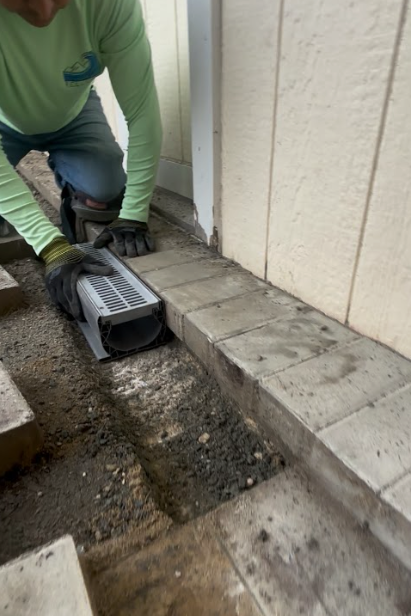
The concrete bedding is like the anchor for your trench drain channel, keeping it firmly in place even with foot traffic. Our outlet pipes are connected with sealed joints and set at the perfect slope, guaranteeing consistent and reliable water discharge.
We always perform flow testing to confirm everything is working perfectly before we reset your pavers and restore your patio to its original beauty.
Keeping It Flowing: How to Maintain Your Trench Drain for Long-Term Foundation Protection
A little routine maintenance goes a long way in keeping your trench drain working like a charm. Simply clearing debris from the grates, flushing the channels, and inspecting the outlets will prevent annoying clogs and backups.
For most residential trench drain patios in Savannah, Pooler, and Richmond Hill, simple seasonal maintenance is usually all it takes.
Easy Tips: Best Practices for Debris Removal and Flushing
Periodically, just lift the grate and clear out any leaves or debris by hand. Give the channel a good flush with a garden hose to wash away sediment. And always check your outlet areas for any signs of erosion or blockage, especially after those intense storms.
One tip: avoid aggressive pressure washing, as it could disturb your surrounding pavers or the bedding beneath them.
How Often Should You Check and Service Your Trench Drain?
Give your trench drain a quick visual inspection quarterly, and definitely after any significant rain events. An annual professional servicing is a great idea to ensure your pipes, bedding, and outlets stay in tip-top condition.
Promptly addressing any reduced flow or pooling helps you prevent water from ever reaching your foundation.
Why Patio Drainage Solutions Are a Must-Have for Georgia Homes
Here in Savannah, Pooler, and Richmond Hill, with our unique combination of clay soils and frequent heavy rainfall, proper patio drainage isn’t just a nice-to-have; it is a must!
Without it, your patio can inadvertently become a funnel, directing water straight toward your foundation and dramatically increasing the risk of costly structural damage. A well-designed trench drain system is truly an investment that protects your outdoor living space and preserves your home’s long-term value.
Local Climate: Georgia Clay Soils and Rainfall
Our local clay soils are notorious for draining slowly and holding onto moisture, which, as we’ve discussed, puts extra pressure on your foundation. Trench drains are a hero here, intercepting that water before it even has a chance to penetrate the soil.
Because of our intense coastal Georgia storms, drainage designs often require higher-capacity channels and super-reliable discharge points to handle the deluge effectively.
Local Rules & Building Codes and Your Drainage Installation
Just a heads-up: local regulations can sometimes influence how drainage systems discharge water and whether permits are needed. A professional installer will always factor these rules into the design and installation process. Partnering with a local contractor ensures everything is compliant and performs beautifully for years to come.
Ready to Give Your Patio and Foundation the Protection They Deserve?
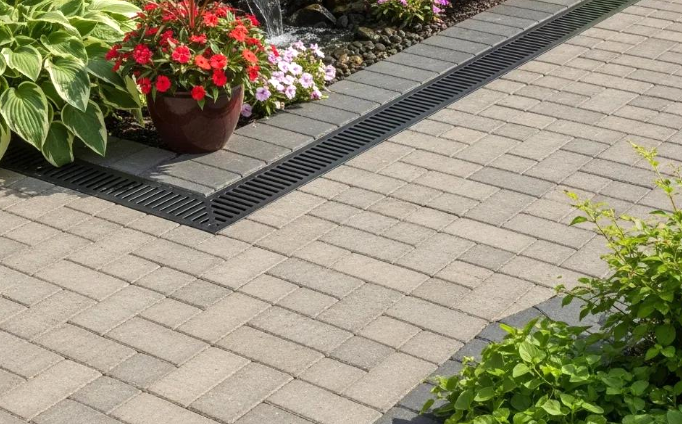
If you’re seeing standing water on your patio, noticing shifting pavers, or just feeling uneasy about moisture near your foundation, please don’t wait! Now is absolutely the time to address it before the damage gets worse. Coastal Hardscapes specializes in creating beautiful, functional trench drain patios and providing professional drainage solutions tailored explicitly for homes right here in Savannah, Pooler, and Richmond Hill.
As an owner-operated company, we pour our heart and soul into every project. Coastal Hardscapes brings hands-on expertise, thoughtful design, and top-notch installation to your home. Miguel personally evaluates each property, clearly explains your options, and designs drainage solutions that truly protect both your cherished outdoor living space and your home’s foundation.
Why not schedule a patio drainage assessment with Coastal Hardscapes today? It’s the easiest first step toward enjoying a dry, stable patio and gaining that tremendous long-term peace of mind.

 Landscaping Concrete Services – What to Know in Savannah!