Homeowners in Rincon, GA, looking to install a concrete patio or fire pit will love what we are about to show off! We recently installed a new patio and fire pit for a homeowner whose backyard had two problems.
First, the old fire pit with its face flaking off in chunks was no longer safe to sit around. And a rectangle of half-dug dirt where a DIY patio had stalled out months earlier and had become a muddy mess. This concrete patio and fire pit project in Barrington Place of Rincon started exactly where a lot of them do: with good intentions and a shovel.
Ultimately, DIY patios are often challenging, and way more laborious than many homeowners might think. Luckily, the team here at Coastal Hardscapes was able to help and provide a budget-friendly solution for this backyard!
The Existing Patio & Fire Pit Issues
Barrington Place is an established neighborhood of a few homes, which means mature yards and homes old enough that the first round of backyard improvements is wearing out. That was the case here. The existing fire pit had been built years earlier, and the block was spalling badly, flaking apart layer by layer around the top course.
On top of the age, the overall structure was not installed properly on the correct base, so sitting around it was no longer something the family wanted to do, and, honestly, they were right to stop.
A few feet away sat the second issue: the homeowner had started building a patio, gotten through part of the excavation, and hit the wall that stops most backyard DIY projects cold. Not the fun part, which is building the patio, but the dirt part.
Neither problem was unusual. What made this project worth documenting is that both failures came from the same root cause, and it is one almost nobody sees coming. However, Coastal Hardscapes was able to step in and save the day, so to speak, and here are the hardscaping solutions we proposed and executed!
Why the old fire pit was crumbling
This is the part homeowners deserve a straight answer on, because “it just got old” is not the reason. Standard concrete blocks and pavers are not built to withstand fire.
Two things are going on inside that block. First, ordinary concrete units are porous and retain moisture, and coastal Georgia’s humidity keeps them holding plenty of it. Light a fire and that moisture flashes to steam faster than it can escape, building pressure inside the block until the face pops off. Second, the aggregate inside concrete expands at a different rate than the surrounding cement, so internal heat pulls the material apart. The industry term for the result is spalling, and it is exactly what the homeowner was looking at.
The numbers make it obvious once you see them. A wood fire burns at roughly 1,100 degrees Fahrenheit, and concrete begins breaking down well below that. Firebrick, by contrast, is made from high-alumina clay, is dense and low in porosity, and holds up to 2,500 degrees. That gap is why a fire pit built entirely from decorative units has a countdown running from the first night you use it.
So the fix is not simply rebuilding the same thing with fresh block. A fire pit that lasts needs a heat-rated liner on the inside doing the real work, with the decorative masonry on the outside handling the looks. Get that backward, and you are scheduling the same repair in five years.
Why the DIY patio stalled at the digging stage
Build Your Project Estimate
The homeowner is not the first person to underestimate this. Have a look below the surface at what a patio actually requires before anything visible happens.
A residential concrete patio wants about 4 inches of slab, and that slab needs 4 to 6 inches of compacted gravel base underneath it. Add the two together and you are excavating 8 to 10 inches of soil across the entire footprint before you have accomplished anything you can see. On a modest 300 square foot patio, that is roughly 8 to 9 cubic yards of dirt to dig, move, and dispose of. By hand, with a shovel and a wheelbarrow, on a humid Effingham County afternoon.
Then comes the part that separates a patio that lasts from one that cracks apart in three years. That gravel base has to be compacted in layers, not dumped in and raked flat, because loose fill settles unevenly and takes your slab down with it. The grade has to fall away from the house at a consistent slope, since poor drainage is the leading cause of patio deterioration and coastal Georgia gives you plenty of rain to prove it. Miss the slope and water pools against your foundation.
None of that requires genius. It requires a plate compactor, a transit or laser level, a truck, and knowing the target numbers. Most homeowners have none of the four, which is why so many of these projects end where this one did.
Designing a concrete patio in Rincon
Here is where we made the decision that shaped the whole project. The homeowner wanted a finished, custom-looking space while keeping the budget reasonable. Those two goals fight each other on most patio jobs.
Material pricing tells you why. Straight concrete runs a lot cheaper per square foot than a full paver installation, and on a patio of any size that difference adds up fast.
| Surface | Typical material cost per sq ft | What you get |
|---|---|---|
| Concrete slab | $5 to $15 | Durable, low maintenance, budget-friendly, plainer look |
| Concrete or stone pavers | $10 to $30 | Custom colors and patterns, individually replaceable units |
| Natural stone (flagstone, bluestone) | $15 to $40 | Highest-end appearance, most expensive to install |
A full paver patio in Rincon would have delivered the look the homeowner wanted at a price they did not want. Pouring plain concrete would have hit the budget and left them with a gray slab. So we did neither.
The patio was poured as a concrete field with a paver border running the perimeter. The concrete carries the square footage cheaply. The border does the visual work, giving the patio a defined edge, some color, and a custom line where a plain slab would just stop. Most of the surface costs concrete money while the eye reads it as a designed space.
We then built the new fire pit using the same border pavers, which tie the whole thing together. The patio edge and the fire pit speak the same visual language, rather than looking like two separate projects that happened to land in the same yard.
“People think the border is decoration. It is the cheapest design money you will ever spend.” That is Miguel’s take on it, and he is right. A few hundred dollars of pavers at the perimeter changes how the entire slab reads.
Installing a new patio and firepit:
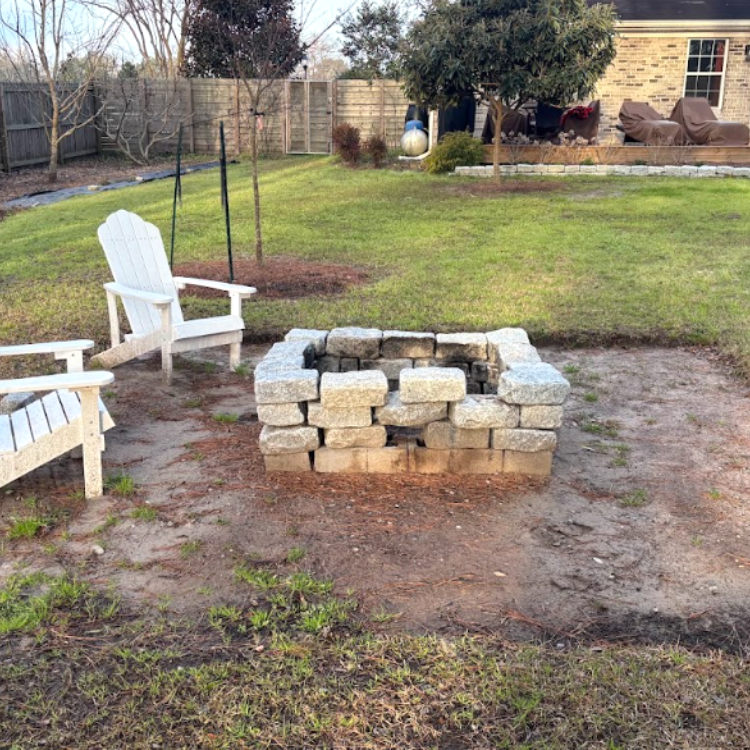
As you can see in the before photo above, the mud and existing fire pit were not the most aesthetic thing. Once we came up with a solution, before ever installing a new patio, whether it is concrete or pavers, it starts with the proper planning and excavation.
Here are the steps we took to help execute the final concrete patio you are about to see below:
- Excavation and correction. We took out the partial dig the homeowner had started, then cut the full footprint to depth. Reworking a partially excavated area is its own small job, since the disturbed soil has to be removed and the grade reset to a consistent plane.
- Base and compaction. Crushed stone was placed and compacted in lifts rather than all at once. Compacting in layers is what keeps the slab from settling later, and it is the single most skipped step in amateur work.
- Grade and drainage. The slab was set to fall away from the house so water sheds toward the yard. In our climate, this is not optional. Rincon sits in a region that gets real rainfall, and a patio that pushes water back against the foundation creates a much more expensive problem than the one you were solving.
- Reinforcement and pour. The slab went in at residential thickness with reinforcement to control cracking. Specifically under the fire pit, extra thickness is worth including because a masonry fire feature concentrates weight in one spot, and a standard slab section can crack under a point load like that.
The paver border was set after the field cured, then the fire pit went up in the same units, sized and placed so there is comfortable seating clearance around it without crowding the grill space at the other end.
Placement deserves more thought than it usually gets. A fire pit wants real distance from the house, the fence, and anything overhead, including tree limbs people forget to look up at. Sited too close to a structure, heat reflects back off the wall and works on both the siding and the fire pit itself. Set it too far out and nobody walks over to use it. We put this one where the family already gathered, far enough off the house to be safe and close enough that the walk from the back door does not feel like a trip.
One last note on timing, since homeowners always ask. Fresh concrete needs curing time before it is ready for use, and keeping the surface damp for the first several days produces a stronger slab with fewer surface cracks than letting it dry out quickly in the Georgia sun. It is the least exciting week of any patio project. It is also the week that determines how the slab will look in ten years.
What does a new concrete patio offer?
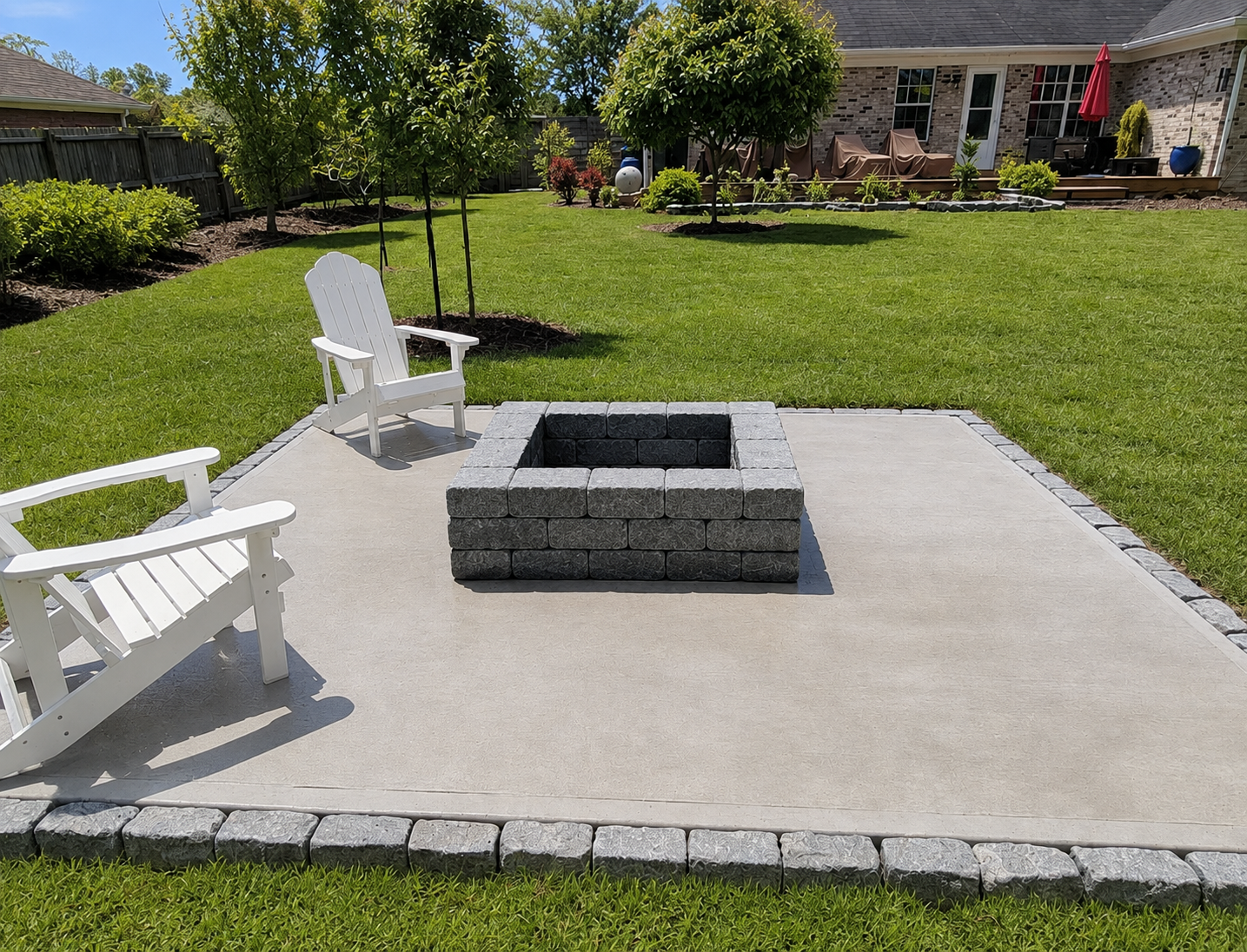
Before, that corner of the yard held a fire feature they had stopped using and a patch of bare dirt with a wheelbarrow parked in it. Now it is one continuous outdoor room. There is solid footing for a table and chairs, room to run a grill without standing in grass, and a fire pit the family can actually gather around on the cool evenings that make fall and winter the best outdoor season in coastal Georgia.
The whole project stayed intentionally simple. No pergola, no outdoor kitchen, no water feature. Just a well-built patio, a clean border, and a fire pit that is not going to fall apart. Sometimes the right answer is not the biggest one.
Would a full paver patio have looked more custom? Slightly. Would it have been worth the additional cost to this homeowner? They decided no, and we agreed with them. Part of our job is telling people when the upgrade is not worth it.
Thinking about a concrete patio and fire pit for your Rincon backyard?
Take one honest look at your yard before you buy anything: where water runs during a hard rain, how far the space sits from your back door, and whether the ground falls toward the house or away from it. Those three observations shape the entire design, and they are the same things we look at on a first visit.
If you have a fire pit coming apart, a patio project that stalled out, or just a patch of yard you have never known what to do with, we would be glad to take a look. Coastal Hardscapes builds patios, fire pits, walkways, and outdoor living spaces throughout Rincon, Guyton, Pooler, Savannah, Port Wentworth, Richmond Hill, and the surrounding coastal communities. Call us at 912-373-6068 for a consultation, and bring your questions about the parts that happen underground.

 Does a New Patio Increase Your Savannah Stormwater Utility Bill?