
Are you looking for a reputable pergola company in Richmond Hill, GA? If so, keep reading to learn how Coastal Hardscapes installs state-of-the-art pergolas.
Friday nights in Richmond Hill belong to the Wildcats. The stands on Wildcat Boulevard fill early, somebody’s neighbor is working the concession window, and for a few hours the whole town stands in the same place cheering at the same thing. Come Saturday, that gathering instinct moves home. It relocates to backyards, around grills and fire pits and folding chairs.
Which is where we tend to come in, and where one hard truth about pergolas in Richmond Hill deserves saying early: bolt a pergola to your paver patio, and you have not built shade. You have built a sail.
Quick Summary: Richmond Hill Pergolas
A pergola can turn an existing patio into a more comfortable, usable outdoor living space, but in Richmond Hill and coastal Georgia, proper installation matters as much as the appearance of a new custom pergola.
Coastal Hardscapes designs and installs custom pergolas with attention to structural anchoring, drainage, material selection, and local coastal conditions. Whether the pergola is added over an existing paver patio or built as part of a new outdoor living project, the goal is to create lasting shade, improve how the space is used, and ensure the structure can handle Georgia’s coastal climate.
The Kenmare Project: Adding Shade to a Patio Worth Keeping


A homeowner in Kenmare called us with what we would call a happy problem. Their brick paver patio was genuinely lovely, well built, and nicely laid, but it needed TLC and a few adjustments. The other issue was that nobody could sit out there. Coastal Georgia sun turned the space into something you crossed quickly on the way to somewhere shadier, and a patio you avoid is an expensive walkway.
Tearing it out would have been the easy recommendation and the wrong one. Good work deserves to stay. So our team designed a custom wooden pergola to sit directly over the existing brick, preserving every paver while adding overhead shade, corner structure, and a gentle sense of separation between patio and lawn.
Change showed up fast, and mostly in small human ways. Morning coffee happens out there now. The grill gets used on weeknights, not just weekends. An open slab exposed to the sky became something closer to a room, one with a ceiling of rafters and a floor the family already loved. Warm natural wood against that brick did not hurt either.
Restraint was the whole design philosophy. Build on what is already good, resist the urge to complicate it, and let the finished space feel like it grew there.
Why Pergola Anchoring Matters More on the Coast of GA:
Twenty years of standing, or a trip across the fence during the next storm. A single detail separates those two outcomes, and it lives entirely underground.
Pavers are a finish surface. They float on sand over compacted gravel; they shift a little as the ground settles, and one paver by itself holds down roughly nothing. Meanwhile, a substantial wooden pergola weighs somewhere between 300 and 600 pounds, and four tall posts catch wind the way a sail does, which is the comparison we keep coming back to because it is uncomfortably accurate. Anchor that structure to pavers alone, and a strong enough gust lifts the pavers right along with it.
Bryan County sits inside coastal Georgia’s hurricane wind zone, where design wind speeds run well above what inland builders plan for. State guidance for coastal areas, including Savannah and the barrier islands, calls for enhanced connections and bracing on outdoor structures. Our weather earned those rules honestly.
Miguel said it best on a walkthrough last spring, standing over somebody else’s failed installation: “Anybody can stand up four posts and a few rafters. The part you cannot see is the part holding it down, and that is the part folks skip, because nobody ever photographs a footing.”
How to Anchor a Pergola Over an Existing Patio
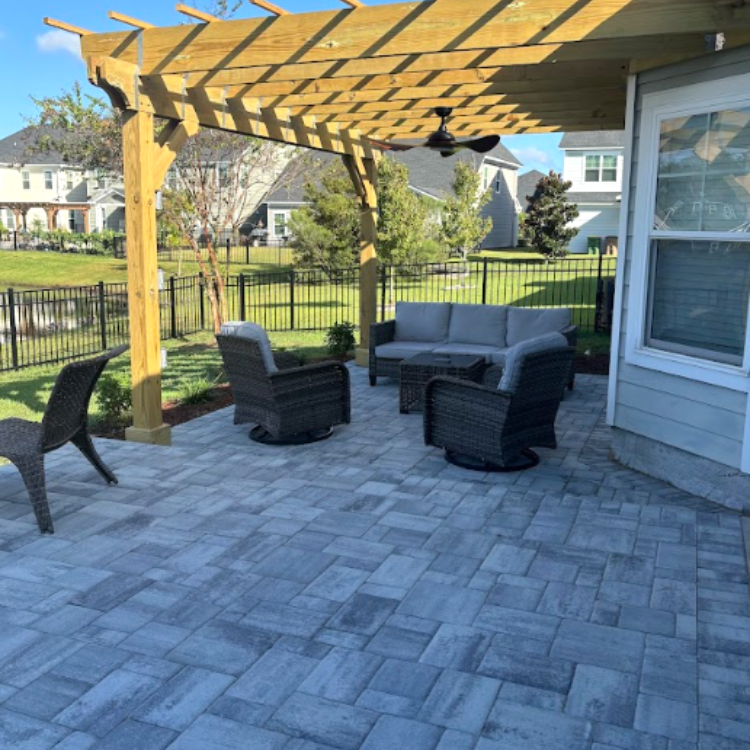
Most of the pergolas we build come with a new patio, so we integrate the two. Essentially, we install the posts with footers, then install the pergola.
However, we also install pergolas with existing patios, like this recent Richmond Hill pergola we built. Doing this properly means reaching past the pavers to something that genuinely holds. Two scenarios exist, and a single test drill at one post location tells you which one you have.
| What sits under the pavers | The right approach | Why it works |
|---|---|---|
| Sand and compacted gravel (most patios) | Lift the pavers at each post, pour concrete footings 12 to 18 inches deep and 12 to 16 inches wide with rebar, set anchor bolts | Reaches stable subsoil underneath everything |
| An existing concrete slab, 4 inches or thicker | Through-bolt with long anchors passing through the paver into the slab | The slab offers real embedment depth |
| Pavers alone, nothing beneath | Not workable for a full-size pergola | Uplift risk in coastal wind |
For those who are really engineering-minded, we don’t mind walking you through the footing method, which covers most patios around Richmond Hill:
- Mark your post locations, then cut or lift those pavers with a masonry saw or core drill instead of brute force, because neighboring pavers crack more easily than anyone expects.
- Dig each footing to depth, drop in rebar, and pour concrete to roughly two or three inches below the paver surface.
- Set J-bolts into the wet concrete, lined up to match the post base plates.
- Give the concrete 24 to 48 hours to set, then a full seven days to cure before the structure carries any load. Waiting out that week tests everyone, and skipping it is the shortcut people regret longest.
- Reinstall the pavers snugly around each post, so the finished pergola looks like it rests on your patio while it is quietly bolted to concrete underneath.
We love that last step. Poured just below paver height and tucked back over, the footings vanish entirely, and the pergola reads as though it has been part of the patio all along. Nobody sees the engineering, which is rather the point.
Best Wood for Pergolas in Richmond Hill’s Climate
Wood choice carries real weight here, more than it would three hours inland. Coastal Georgia hands a pergola heat, humidity, salt-touched air, 40 to 55 inches of rain a year, and a high-activity termite zone, all at once.
| Wood | Relative cost | How it lives here | Where it shines |
|---|---|---|---|
| Pressure-treated pine | Lowest | Treated against rot and termites, though it twists and checks as it dries | Posts and structure, especially near grade |
| Western red cedar | Mid to high | Natural oils give 30 to 50 percent longer decay resistance than treated pine in humid climates, and it stays put dimensionally | Rafters and everything you look at |
| Cypress | Mid | Naturally oily, rot-resistant, wonderfully regional, though supply comes and goes | A happy middle ground when we can source it |
Combining them is common and sensible: treated material down low where the ground is, cedar overhead where your eye lands. Cedar does want a stain or sealant before installation and again roughly every other year, which is honest maintenance rather than fine print. Think of it as the same deal you make with anything worth having.
Pergola Permits and Code Requirements in Coastal Georgia
Three code items regularly surprise homeowners, and each one traces straight back to our climate.
Georgia’s residential code requires any wood member within 12 inches of the ground to be pressure-treated or a naturally resistant species, since the state sits in a high-termite-activity zone. Posts touching concrete fall under the same rule. Termite damage to unprotected posts stays a common problem statewide, and it is a sad way to lose a beautiful structure.
Fasteners get their own requirement. Georgia’s prescriptive details call for corrosion-resistant screws, bolts, and hardware throughout, a direct answer to our humidity. Near salt air, stainless outperforms galvanized and pays for itself. Modern treatment chemistry also eats ordinary fasteners, so hardware selection is structural work, not a detail.
Permitting depends on jurisdiction, and freestanding covered structures often require it. Setbacks and lot coverage rules may apply, and HOA architectural review is common across Richmond Hill neighborhoods. We handle that paperwork on projects we build, which saves you two phone calls and a certain amount of hold music.
How Much Does a Pergola Cost in Richmond Hill?
Wood for pergola construction runs roughly $15 to $25 per square foot in materials before labor, and labor generally accounts for 50 to 70 percent of a hardscaping project’s total. A rough doubling of the material figure gets you in the neighborhood of an installed estimate.
What affects the cost of a pergola
- Size and post count. Anything over 8 by 8 feet needs full concrete footings, and each additional post adds excavation, concrete, and cure time.
- Wood species. Cedar throughout costs noticeably more than a treated frame with cedar rafters overhead.
- Condition of the existing patio. Sound pavers keep everything simple. A patio that has settled unevenly needs correcting before building anything above it.
- Attached or freestanding. Attaching to the house calls for proper ledger flashing so water cannot sneak behind your siding, which adds labor and matters enormously given our rainfall.
- The extras. Lighting, fans, retractable canopies, and privacy panels all widen the scope, usually in ways people are glad about later.
Pergola Design Ideas for Richmond Hill
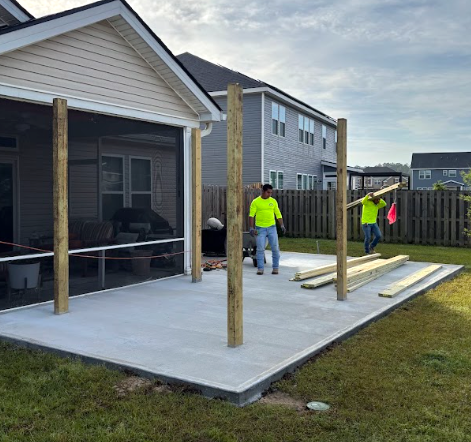
What are the best pergola designs for the Richmond Hill area?
The best pergola designs for Richmond Hill balance shade, airflow, and how you plan to use the space throughout the day. Rafter direction plays a big role. North-to-south rafters create changing shade as the sun moves, while east-to-west rafters can provide stronger midday coverage for patios used most often during the hottest part of the day. Tighter rafter spacing or added top slats can create more shade, while a more open design allows for better airflow and a lighter, more open feel.
Pergolas also play beautifully with what Kenmare backyards already tend to have. A fire pit set just outside the pergola footprint stretches your season into the cool months without putting flame beneath a wood structure, which is the arrangement we always recommend. Landscape lighting on the posts turns the whole thing into an evening room. String lights hang cleanly from beams regardless of species, and yes, people ask us about string lights more than almost anything else.
One sequencing note that saves money and heartache: sort drainage first. Settle how water moves across a yard before a patio, pergola, or fire feature goes in, because fixing grading afterward means disturbing finished work you just paid for.
Your Patio Already Earned a Ceiling
Go stand on your patio this week, ideally around two in the afternoon when the sun is being obnoxious about it. Two things will tell you almost everything. Notice how much of that space is genuinely unusable in the heat, because that is the square footage a pergola hands back to you. Then find out what lives under your pavers, since sand-set and slab-set patios call for completely different anchoring, and that one answer shapes your whole estimate.
Picture it finished.
Rafters overhead throwing stripes across the brick, a grill going on a Tuesday, string lights on by seven, and a patio your family actually fights over instead of hurrying across. The best pergolas in Richmond Hill are built on something a family already loves, which is precisely the Kenmare story, and it could just as easily be yours.
Coastal Hardscapes designs and builds pergolas, patios, fire pits, and complete outdoor living spaces across Richmond Hill, Savannah, Pooler, Rincon, Guyton, Port Wentworth, and every coastal community in between.
Reach out below, call our Coastal Hardscapes hardscaping team at 912-373-6068, or start with an online estimate. Bring your questions about the parts that end up buried, too. Those are the ones we love talking about.
Frequently Asked Pergola Questions
1. Can you build a pergola over an existing paver patio in Richmond Hill, GA?
We can absolutely build a custom pergola over an existing patio or hardscape structure. Part of our design process is helping you pick out the best pergola for your project. If the paver patio or concrete slab is large, we can install the pergola on top of it or next to it, and we can help with all of that during the consultation. An existing patio simply adjusts how we secure the pergola.
2. Do pergolas need concrete footings in coastal Georgia?
While a pergola doesn’t require concrete footings, we typically recommend them because of the coastal storms and hurricanes in Richmond Hill. The more stable your pergola’s footing, the safer it will be and the better it will withstand storms. However, some installation methods don’t require concrete footings.
3. How much does it cost to build a pergola in Richmond Hill, GA?
Most custom pergolas start at around $2,000 and can go up from there depending on size, material selection, existing conditions, and whether you want to add extras like electricity, lights, fans, and more.
4. What is the best material for a pergola near Savannah and Richmond Hill?
We recommend pressure-treated timbers for your pergola in Savannah and Richmond Hill for many reasons, but mainly for durability and affordability. Wood pergolas are a great choice because we can accommodate custom extras, a variety of sizes, freestanding pergolas, and more.
5. Do I need a permit to build a pergola in Richmond Hill?
Not all pergola projects require a permit, but it all depends on a few factors. Whether a pergola requires a permit in Richmond Hill depends on its size, design, location, and how it’s built. HOA requirements, setbacks, and whether the pergola is attached to the home can also affect what is required. We recommend confirming current requirements with the appropriate local permitting office before you begin construction.

 Sod Installation in Savannah, GA: What It Costs, What to Expect, and How to Get It Right