
If you are a property manager in the Savannah, GA area and your apartment complex pool deck needs a new patio or repair, where should you start? What if the pool deck needs resurfacing but that pool is ok?
As a property manager, you may think your pool deck costs you a lot, and most people in your shoes will point to the patio repair invoice as the reason. However, the real cost is elsewhere: the tour that ended early because the amenity area looked tired, and the renewal that didn’t happen.
Apartment complex patios in Savannah, Pooler, and Richmond Hill carry a workload no backyard patio ever sees: hundreds of residents instead of one family, chemical exposure, ADA obligations, and a leasing office that needs the space photogenic on a Saturday morning.
Whether you need apartment complex patio repair, resurfacing, or a new patio installed, this guide will walk you through the process.
Apartment Complex Patios in Savannah: Quick Summary
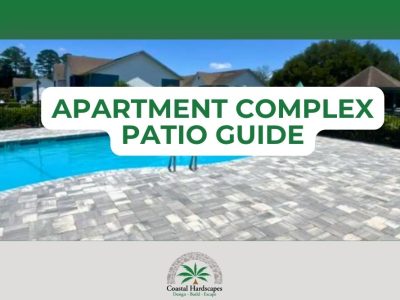
We recently replaced the entire pool deck at an apartment complex in Richmond Hill, as shown below. During that process, the property managers asked several questions prior to us completing the work, and here are some of those questions and answers we provided when it comes to patio repairs and replacements:
| Question | What Property Managers Should Know |
|---|---|
| What surfaces work best for apartment pool decks in Savannah and Pooler? | Concrete pavers and poured concrete can both work, but pavers are easier to repair and provide simpler access to utilities beneath the surface. |
| Why do apartment pool decks and patios fail? | Patios and pool decks can fall apart and crack for several reasons, including poor base preparation during initial installation or drainage problems. Other causes of patio repairs include heavy resident traffic, chemical exposure, settlement, and deferred maintenance that leads to cracks and issues over time. |
| Does ADA accessibility matter for apartment patios and pool decks? | Common-use areas within apartment complexes may need accessible routes, proper transitions, controlled slopes, and stable, firm, slip-resistant walking surfaces, so factor that in with new patios or resurfacing. |
| Is drainage important around apartment pools? | Yes. Pool decks should be designed so water moves away from the pool or toward appropriate drainage, rather than creating standing-water areas. |
| Can apartment hardscaping projects be completed while residents are on site? | Yes. Larger projects can often be phased into sections to reduce amenity closures, parking disruption, and inconvenience for residents. |
| How much does commercial hardscaping cost in Savannah? | Costs vary significantly based on materials, demolition, base repairs, drainage, accessibility work, project size, and how the work must be phased around an occupied property. |
Richmond Hill Apartment Complex Pool Deck Transformation: From Concrete to Pavers
For apartment communities in Richmond Hill and Savannah, the pool area is one of the most important outdoor amenities – for residents and property managers. It’s where residents gather, families spend their weekends, and prospective tenants get a first impression of the property. An outdated concrete pool deck can take away from an otherwise beautiful apartment community. As a property manager, you want to ensure your pool area looks its best for prospective renters.
That was the opportunity at this Richmond Hill, GA apartment complex where we recently installed a new paver system to replace the existing pool deck.


The property had an existing concrete pool deck, but management wanted to upgrade the appearance and create a more inviting outdoor space for residents. Rather than settling for the original concrete finish, Coastal Hardscapes of Georgia helped transform the pool area with a new paver installation.
Our team evaluated the existing concrete surface, pool edges, elevations, and drainage considerations to determine the best approach for installing the new pavers. When installing pavers over an existing concrete pool deck, proper preparation is essential to creating a finished surface that looks great and performs well over time.
The finished project features a beautiful combination of gray and lighter-toned pavers that complement the pool and surrounding apartment buildings. The updated design gives the entire amenity area a cleaner, more modern appearance while creating an attractive outdoor gathering space for residents.
For property management companies throughout Richmond Hill, Savannah, Pooler, and coastal Georgia, projects like this demonstrate how commercial pool deck renovations and paver installations can dramatically improve an existing property’s appearance without requiring an entirely new pool. This gives you the look and feel you want without breaking the bank.
Whether your apartment complex needs concrete patio repairs, pool deck resurfacing, or a complete outdoor amenity renovation, Coastal Hardscapes provides commercial hardscaping solutions designed around your property’s needs, long-term maintenance, and resident experience.
Why do Apartment Pool Decks, Walkways, and Patios need more repairs?
We often hear this question from property managers: Why do patios at our complex need repairs?
Think about it from a usage standpoint. A typical backyard patio and a 250-unit amenity deck can be built from identical pavers and age two decades apart. What we mean by this is a family of four sitting on the patio a few nights a week vs 300 residents traversing a walkway daily leads to more wear and tear.
Here are the top six reasons we repair pool decks and paver patios for our clients here locally in Savannah, Pooler, and Richmond Hill:
1. Foot traffic that never lets up.
A family patio hosts maybe six people on a good weekend. A community pool deck hosts a few hundred residents, their guests, dragged chairs, wheeled coolers, and a maintenance cart doing rounds. Foot traffic alone does not crack a deck, but it accelerates everything else on this list, and it never takes a season off the way a private backyard does.
2. Pool chemicals on the pool deck
Chlorine and salt constantly splash out onto the surface, and cleaning agents add their own load. Material choice matters more here than in any residential setting. Brick pavers, governed by ASTM C902, have limited chemical resistance, which is survivable beside a home patio but a real liability around a commercial pool.
3. Patio base installed incorrectly
The failing patio nobody sees coming lives twelve inches down, in the original base for the patio or walkway. Coastal Georgia soil moves, and pool decks installed without proper sub-base drainage crack disproportionately within three to seven years. HUD attributes roughly $6 billion in annual U.S. structural damage to expansive soil movement. Base preparation is the least visible line on a commercial bid and the worst one to trim.
4. Slope that has to satisfy code, not just gravity.
Residential patios need water to run away from the house. Wet decks at a multifamily property must slope away from the pool or into deck drains, at a 2 percent minimum and 4 percent maximum, with paver decks permitted a 1 percent minimum. Standing water on an apartment pool deck is a code violation, a slip claim waiting to happen, and what residents photograph.
5. Accessibility obligations required for patios/pool decks
Common-use amenities trigger requirements private patios do not. Accessible routes must stay continuous and unobstructed, level changes over 1/4 inch need beveling, and paver joints along those routes cannot exceed 1/2 inch in the direction of travel. Settlement that would be a cosmetic annoyance at a house becomes an ADA exposure at a community.
6. Deferred maintenance leads to more repairs
Homeowners fix the wobbly paver because they trip on it. At a property, small defects queue behind unit turns and roof bids until they stop being small. Add utility lines running under most amenity decks, and a poured slab means saw-cutting to reach them, so minor repairs get postponed precisely because the repair method is so disruptive.
Our Top 4 Solutions for Apartment Pool Deck, Walkway, and Patio Repairs in Savannah
Not every damaged patio or pool deck needs to be completely torn out and replaced. In fact, one of the first things we evaluate at Coastal Hardscapes of Georgia is whether we can repair, resurface, or upgrade the existing surface without a full reconstruction.
For apartment complexes, HOAs, and commercial properties throughout Savannah, Pooler, and Richmond Hill, we recommend solutions that address the underlying problem, improve the property’s appearance, and minimize disruption to residents.
Here are four common solutions we provide for commercial hardscaping projects in coastal Georgia.
1. Commercial Paver Patio and Walkway Repairs
Uneven pavers, sinking walkways, loose edges, and damaged patio sections are some of the most common issues we encounter at apartment communities throughout Savannah.
The good news is that not every problem requires replacing the entire patio.
Depending on the condition of the existing installation, our team can remove affected pavers, address underlying base issues, restore proper elevations, and reinstall materials that remain in good condition.
This is especially useful for apartment complexes with established paver walkways connecting buildings, parking areas, clubhouses, and outdoor amenities.
Instead of replacing hundreds of square feet unnecessarily, targeted commercial paver repairs can extend the life of an existing installation while improving safety and appearance.
2. Concrete Pool Deck Resurfacing With New Pavers
One of the most noticeable upgrades an apartment community can make is transforming an outdated concrete pool deck with new pavers.
We recently completed this type of project at an apartment complex in Richmond Hill, Georgia, where we upgraded the existing concrete pool area with a beautiful combination of gray and lighter-toned pavers.
Depending on the condition of the concrete, drainage, elevations, and pool coping, installing pavers over an existing slab may be an option without demolishing the entire deck.
This approach can provide several advantages for property managers, including an updated appearance, a wider selection of finishes, and the ability to replace individual damaged pavers in the future.
For apartment owners comparing pool deck resurfacing versus complete replacement in Savannah or Richmond Hill, evaluating the existing concrete is the first step toward choosing the right solution.
3. Complete Patio, Pool Deck, and Walkway Replacement
Sometimes repairs are no longer the most practical long-term solution.
If an apartment walkway has extensive settlement, a concrete patio has widespread cracking, or a pool deck has underlying drainage and structural problems, replacing the affected area may make more financial sense than repeated repairs.
For these projects, Coastal Hardscapes evaluates the existing conditions before recommending a new installation. That includes considering soil conditions, base preparation, drainage, surface materials, and how residents will use the finished space.
We can also provide custom design renderings for larger outdoor living renovations, giving
Pavers Versus Concrete for Apartment Complex Surfaces
Both materials work in multifamily settings. They fail differently, repair differently, and cost differently over time.
| Factor | Concrete pavers | Poured concrete |
|---|---|---|
| Repairs | Individual units lift and reset, no color-matched patch | Patches rarely match; cracks spread |
| Utility access | Lift pavers, work, reset the same units | Saw cut and pour, permanent scar |
| Slope minimum | 1 percent permitted on paver decks | 2 percent minimum |
| Settlement | Flexes with soil movement rather than cracking | Cracks at stress points |
| Upfront cost | Higher per square foot | Lower per square foot |
| Governing spec | ASTM C936 for interlocking units | Mix design and finish specification |
The utility access line deserves more weight than it usually gets in a bid comparison. Pool equipment lines, irrigation, and electrical for lighting frequently run beneath amenity decks. When something needs attention under a poured slab, you cut concrete and live with the repair forever. Under pavers, a crew lifts the affected units, does the work, and resets the same pavers. Nobody can tell afterward.
Miguel makes the same point on commercial walkthroughs, usually while standing on somebody’s cracked slab: “On a property you plan to hold for fifteen years, the question is not what it costs to install. It is what it costs to open up three years from now when something underneath needs fixing.”
Patio and Pool Deck Considerations for Apartment & Condos:
When repairing or replacing patios, walkways, and pool decks at apartment complexes and condominium communities in Savannah, Pooler, and Richmond Hill, appearance is only one part of the equation.
Unlike residential patios, multifamily outdoor amenities must account for higher foot traffic, accessibility requirements, slip resistance, proper drainage, and long-term maintenance. Property managers and HOA boards also need to consider how these improvements affect resident safety, potential liability, and compliance with applicable building codes.
Before starting a commercial patio repair or pool deck renovation in coastal Georgia, property owners should understand several key factors.
ADA Requirements for Multifamily Pool Decks and Patios
Common-area amenities at apartment communities carry accessibility obligations that private backyards do not, and the local authority having jurisdiction determines exactly where the threshold lands for your property.
Several requirements come up on nearly every project:
- Accessible means of entry. Newly constructed or altered pools must provide accessible entry, with a lift or sloped entry as the primary compliant options. Pools with more than 300 linear feet of pool wall generally require two accessible means of entry, while smaller pools generally require one.
- Continuous accessible routes. The route serving the pool must be unobstructed, typically at least 36 inches wide, with surfaces that are stable, firm, and slip-resistant under ADA Section 302.1.
- Level changes. Vertical changes up to 1/4 inch are acceptable without treatment. Between 1/4 and 1/2 inch, they must be beveled at 1:2. Anything beyond 1/2 inch requires a ramp.
- Joint width. Openings in a walking surface, including paver joints, cannot exceed 1/2 inch in the direction of travel, which quietly disqualifies certain paver patterns along accessible routes.
- Cross slope discipline. A designed 2 percent cross slope often lands at 2.5 or 3 percent in the field because installers vary by half a point to a full point. Experienced commercial crews design to roughly 1.5 percent and verify with a digital level, since anything over 2 percent has to be ground down or replaced before acceptance.
Pool deck code adds its own layer. Wet decks must be nonabsorbent with a smooth slip-resistant finish; wooden decking is prohibited, and the surface must slope away from the pool or toward deck drains so water cannot stand. Minimum slope runs 2 percent with a 4 percent maximum, though paver decks are permitted a 1 percent minimum, which gives designers useful room on tight sites.
The Slip Resistance Standard Most Vendors Get Wrong
Somebody has quoted you a 0.60 coefficient of friction and called it the ADA requirement. That number is worth understanding, because it is not what people think.
Early accessibility guidance suggested static COF values of 0.60 for walking surfaces and 0.80 for ramps, but those figures lived in an advisory appendix, were never adopted as binding, and have since been withdrawn. The enforceable ADA Standards contain no numeric slip-resistance threshold. They require surfaces to be stable, firm, and slip-resistant, which means a vendor calling a product “ADA compliant” based on a tribometer reading is telling you something that sounds precise but isn’t.
What actually protects a property owner is documentation against a current consensus standard. ANSI A326.3 measures dynamic coefficient of friction using a BOT 3000E tribometer, with a common acceptance criterion of 0.42 or higher for level interior wet surfaces, and ASTM E303 pendulum testing serves a similar role. The 2024 International Swimming Pool and Spa Code now references recognized slip-resistance methods for wet walking surfaces around pools, which pulls deck traction squarely onto the code radar.
Practical translation for a property manager: ask your contractor which standard the specified product was tested to, get the documentation, and keep it in the project file. Should a slip-and-fall claim ever arrive, a tested product with paperwork is a materially better position than a vendor’s verbal assurance.
Scheduling Work Around Residents
Occupied-property logistics separate a good commercial hardscaping contractor from a good residential one, and the difference shows up in your inbox, not the finished product. We mean we understand that navigating around your residents is vital. This starts with preparation, and we understand that amenity downtime carries real leasing cost, particularly between April and September when a Savannah pool is a primary touring feature.
Phasing the installation of a new apartment complex patio, walkway, or pool deck takes careful planning, and here are the steps we take:
- Split the deck into zones so part of the amenity area stays usable, rather than closing everything for the full duration.
- Schedule the loudest work for mid-morning through mid-afternoon, avoiding early mornings and evenings when residents are home.
- Stage materials somewhere that doesn’t eliminate resident parking, which generates more complaints than the construction itself.
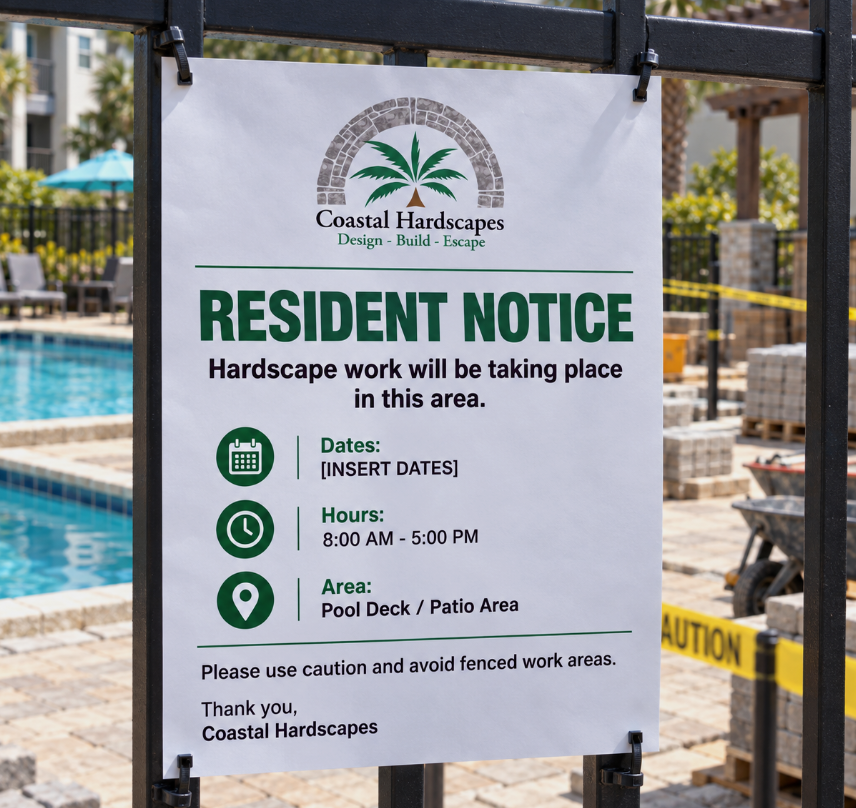
- Set the barrier line once with proper fencing and clear signage, since a controlled jobsite generates far fewer calls to the leasing office than a scattered one.
- Target the shoulder season where the calendar allows, because deck work in October costs the property much less in resident goodwill than the same work in June.
Written notice to residents ahead of each phase costs nothing and prevents most of the friction. Property managers who have lived through a badly run amenity project tend to ask about this before they ask about price.
What Apartment Complex Hardscaping Costs in Savannah
Commercial hardscaping generally runs $15 to $50 per square foot, climbing with material grade and design complexity, and labor typically accounts for 50 to 70 percent of the total. Material ranges are as follows:
- concrete or stone pavers at $10 to $30 per square foot,
- natural stone at $15 to $40, brick at $10 to $20, and
- concrete slabs at $5 to $15, all before installation.
That said, just sharing material prices doesn’t give a property manager the full picture of costs. There are other variables specific to multifamily unit hardscaping and patio work:
- Demolition and disposal of an existing failed deck, which residential estimates often understate at commercial scale.
- Base correction, the single largest hidden cost, especially where the original deck was built on inadequate sub-base.
- ADA route work, including any lift pad, sloped entry, or transition corrections triggered by an alteration.
- Drainage, since standing water on a wet deck is both a code issue and a liability issue.
- Phasing, because zone-by-zone work costs more in mobilization than closing the whole area at once.
Let’s Make the Amenity Photo Worth Taking
Our goal is to help you! That means we want you to use your outdoor amenities to your advantage as you look to help your residents – both new and current. We do this by making outdoor design and build construction plans simple for you! Walk your pool deck on a Saturday afternoon this month, when it is busy, and look at three things:
- standing water anywhere after a rinse,
- level changes at transitions and drains, and
- how the surface reads in photographs.
Those three will tell you if you are looking at a maintenance item, a liability exposure, or a marketing problem, and often it turns out to be all three wearing the same jacket.
Coastal Hardscapes partners with property management companies, apartment communities, HOAs, hotels, and commercial property owners throughout Savannah and coastal Georgia. Our team provides professional installation and renovation of pool decks, patios, walkways, retaining walls, drainage systems, and other high-use outdoor areas, emphasizing long-term performance, thoughtful project planning, and minimal disruption to residents and operations.
If you are evaluating an upcoming capital improvement, amenity renovation, or commercial hardscaping project, contact the expert team here at Coastal Hardscapes at 912-373-6068 to schedule a site consultation. References from comparable commercial and multifamily projects are available upon request.
Frequently Asked Questions About Apartment Complex Patios in Savannah
1. What is the best material for an apartment complex pool deck in Savannah?
Concrete pavers and poured concrete are both commonly used for multifamily properties, but they offer different advantages. Pavers can be particularly useful for properties where future repairs or underground utility access may be necessary because individual sections can be removed and reset. The right surface should also account for drainage, slip resistance, heavy traffic, and long-term maintenance.
2. Why do apartment pool decks crack or become uneven?
Apartment pool decks can become uneven because of settlement, inadequate base preparation, drainage problems, heavy use, and movement in the underlying soil. On a commercial property, small surface problems can become more significant because hundreds of residents and guests may use the area regularly. Correcting the base and drainage is often more important than simply resurfacing the visible deck.
3. Do apartment pool decks have to meet ADA requirements?
Common-use areas at multifamily properties can be subject to accessibility requirements that do not apply to private residential patios. This can include requirements involving accessible routes, surface transitions, slopes, openings, and stable, firm, slip-resistant surfaces. Exact requirements depend on the property and the authority having jurisdiction, so evaluate accessibility during the planning process.
4. Are pavers or concrete better for apartment complexes?
Neither patio or walkway material is automatically best for every property, with factors like budget and size always a consideration. Poured concrete typically has a lower initial cost, while concrete pavers can make future repairs and utility access easier because you can lift and replace individual units. For properties expected to be held long term, maintenance and repairability can matter as much as the initial installation cost.
5. Can you replace an apartment pool deck without closing the entire amenity area?
In many cases, yes. Commercial hardscaping projects can be divided into phases so sections of an amenity area remain available while other sections are under construction. Proper staging, barriers, resident communication, material storage, and scheduling can help reduce disruptions to residents and property management during the project.

 Pergolas in Richmond Hill, GA: How to Add Shade to a Patio You Already Love